Intake Triage Classification Models for Workplace Complaints
A four-layer triage model separates prediction from permission to act.
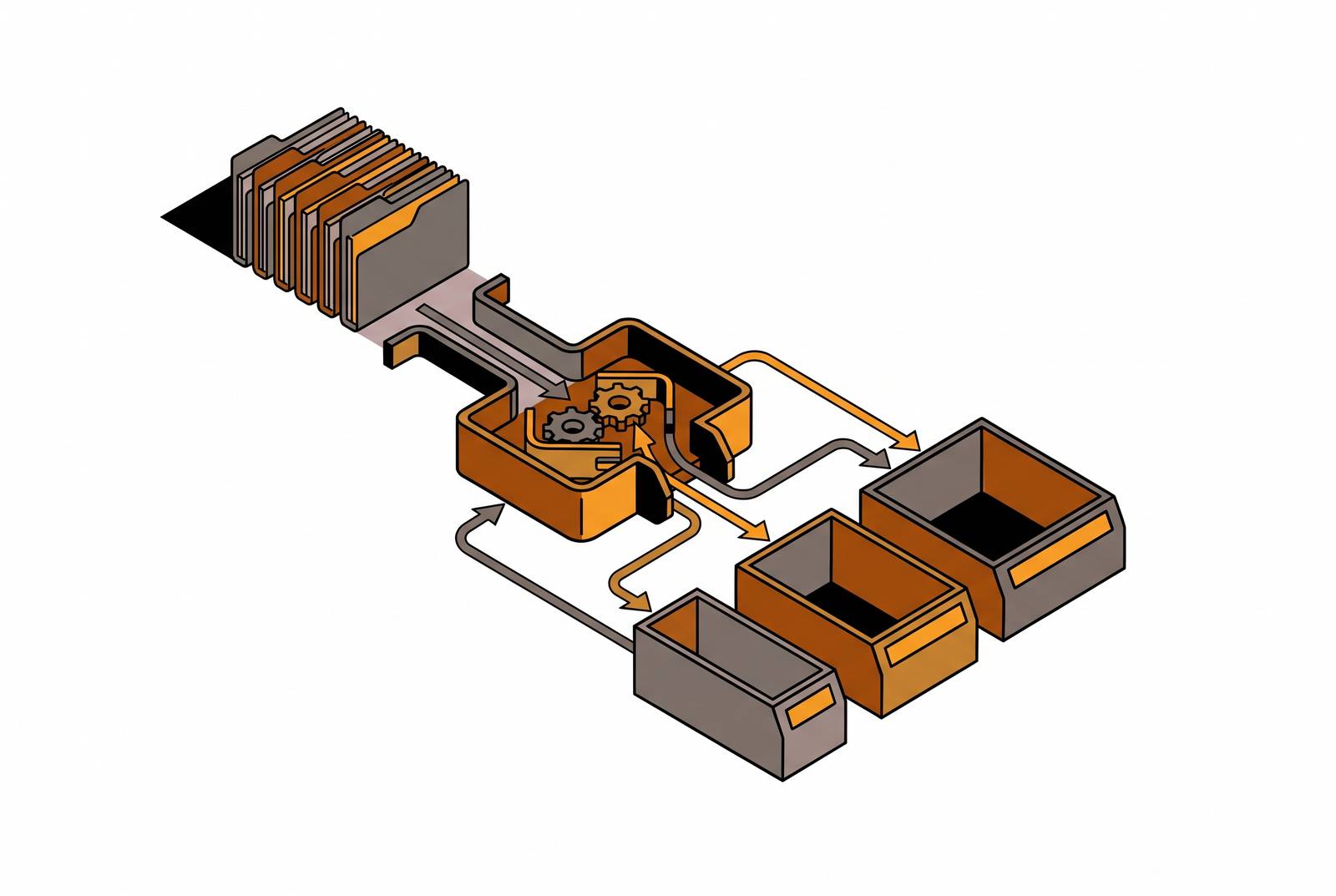
Workplace complaint intake requires more than a model that assigns labels. Effective triage depends on four linked outputs, namely category, severity, regulatory tag, and routing confidence. Together, these determine which workflow applies, how urgently it must proceed, and when human review must intervene. This layered architecture is the practical foundation for building a complaint pipeline whose decisions can be explained, governed, and measured.
Why workplace complaint intake is structurally suited to AI classification
Complaint queues combine three conditions that make classification useful, namely growing volume, recurring patterns, and observable outcomes. Reports arrive through email, web form, and phone, but the assessment must remain consistent regardless of channel or phrasing. As volume grows, manual intake struggles to keep up and treat reports in the same way. Classification addresses that structural problem by applying a shared taxonomy to varied accounts.
The bounded nature of that taxonomy matters more than the breadth of an AI system’s capabilities. Most cases in a mature HR or compliance queue fall into recognizable categories, including harassment, wage dispute, safety, and discrimination. Those recurring patterns give a trained classifier something demonstrable to learn. Intake also has measurable boundaries, with cycle time, escalation rate, and misrouting rate observable before and after deployment.
The four-layer classification architecture a complaint triage model must implement
Category assignment establishes which policy framework, SLA, and team apply. Because one report can contain both a harassment allegation and a wage claim, this layer must support multi-label output. Severity scoring then estimates urgency and potential harm, distinguishing an immediate safety risk from a policy dispute or documentation error. It determines queue priority as well as the response deadline. Prior reports can change that assessment, so severity cannot depend on the new complaint’s wording alone.
Regulatory tagging identifies the applicable frameworks, including Title VII, OSHA, FLSA, HIPAA, state-specific employment law, and GDPR for cross-border cases. Several tags may apply to one ticket, with the shortest applicable SLA governing the workflow. Selecting those tags requires jurisdiction, complaint content, and the respondent’s role. The system must also expose the phrases that triggered a tag so compliance reviewers can examine its basis.
Routing confidence governs whether the combined output is sufficient for autonomous routing. At or above the configured threshold, an eligible complaint can route with an AI-generated summary pre-filled. Below it, or where legal exposure requires review, the model’s reasoning accompanies the ticket to a human. Elementum’s architecture makes these thresholds configurable by workflow step and process. The architecture therefore separates a prediction about the complaint from permission to act on that prediction.
How NLP intent and sentiment detection work inside a complaint classifier
NLP-based classifiers detect intent, sentiment, and topic through learned language patterns. This allows them to handle indirect allegations, unfamiliar phrasing, and complaints embedded in longer narratives more effectively than keyword rules. Topic tells what the issue is, and sentiment helps show how emotionally urgent it is. Two overtime complaints may both concern a wage dispute, yet escalating distress in one may warrant a different severity assessment. Sentiment contributes to that assessment without supplying the missing case context.
That distinction defines the limit of language classification. DevRev’s framework distinguishes NLP-based classification from knowledge graph and agentic systems that can work across source systems and retrieve broader context. A classifier needs those additional layers to find records of prior incidents or understand the roles the parties have in the organization. Retrieval-augmented generation or reasoning layers can also display the exact phrases behind a classification, making its basis inspectable.
Even with those additions, the training corpus limits how well classification can work. Gaps in datasets and wrong assumptions can lead to errors that follow a pattern. Past under-reporting or biased HR decisions can thus affect what the model predicts for both category and severity. Even when a model handles language better, what it learned still needs to be checked.
When confidence thresholds govern autonomous action and when they require human review
Confidence thresholds set the bounds of decision authority as well as the preferred automation rate. They should vary by complaint category, severity, and regulatory exposure. A low-severity wage classification dispute may qualify for autonomous routing under conditions that would not permit a discrimination or retaliation allegation to proceed without review. High confidence establishes only that the model has met the confidence condition for an otherwise permitted action.
This boundary also separates probabilistic judgment from deterministic execution. Elementum’s governance model assigns classification to AI agents, SLA enforcement to rules, and judgment calls to humans within the same workflow run. AI can give different outputs for similar inputs, but a deadline rule must run the same way each time. Reserving reasoning for intent and severity prevents uncertainty in those tasks from spreading into fixed workflow obligations.
When review is required, the ticket should arrive with its category, severity, regulatory tags, confidence score, and triggering phrases. The reviewer can then assess the model’s reasoning using the assembled intake information. For complaints carrying employment, discipline, or legal consequences, human review is a control. Meaningful oversight requires authority to reject an output that is inaccurate, incomplete, misleading, or unsupported.
Regulatory tagging requirements that vary by industry and jurisdiction
Regulatory tagging must be configurable because jurisdictional variation is a baseline condition for organizations operating across state lines or internationally. The GDPR (2016) and the EU AI Act impose transparency and impartiality requirements relevant to automated HR decisions. Complaint systems affecting EU employees therefore need explainable, auditable outputs. California’s employment law framework prohibits automated decision systems that discriminate against applicants or employees based on protected traits. It also requires detailed records for at least four years, while voluntary anti-bias testing serves as a defense mechanism.
Industry constraints change the routing design as well. Healthcare complaints involving patient grievances or HR matters touching protected health information require routing gated by protections for that information, and the agent layer must operate under a Business Associate Agreement. Legal services also have rules for attorney-client privilege, version control, and auditability. In financial services, Reg E and CFPB timelines can make complaint deadlines regulatory obligations.
These differences make the tag layer both a routing control and an audit record. Each applicable tag and its reasoning must remain retrievable, and the workflow must enforce the shortest applicable SLA. A generic category label cannot carry all of those obligations. The architecture must preserve the distinction between what the complaint concerns and which rules govern its handling.
Where historical training data introduces bias into complaint classification
If historical complaints from certain populations received lower severity scores or less investigation, a model trained on those decisions can reproduce that treatment. A pre-filled summary and a low severity score can anchor the reviewer’s judgment, while review fatigue further weakens the assumption of an independent reassessment. Human involvement is necessary in consequential cases, but it does not make the underlying predictions neutral.
The engineering response begins before training with an audit of historical underrepresentation and inconsistent treatment. After deployment, regular checks of protected class outcomes can show whether those patterns continue. Explainability supports this work by exposing whether triggering phrases correlate with protected characteristics. Confidence calibration also matters when complaints from certain populations tend to get lower confidence scores. The threshold architecture can require more frequent review for those cases rather than applying a uniform gate without examining its effects.
These controls argue for a more rigorous classification architecture. Bias testing, representative data, inspectable reasoning, and calibrated review address different points where inequity can enter the workflow. None substitutes for the others. Their combined purpose is to make unequal treatment detectable and correctable rather than hide it behind an apparently consistent label.
What the full logging and audit infrastructure must cover
Logging must reconstruct the complete path from complaint receipt to final disposition. At the event level, this includes the raw complaint text, channel, timestamp, category, severity, regulatory tags, confidence score, and routing decision. It must also record human overrides and the final outcome. Every agent action, prompt, tool call, decision, and output must be timestamped and attributable. Without that chain, a challenged decision cannot be traced back to what the model actually saw.
Retention must account for California’s requirement of at least four years and the GDPR’s retention and access obligations. Performance review also depends on preserving classification and review events over time. More escalation within a category and confidence band can be a sign of drift, while human corrections that recur show where retraining may help. A final routing label alone cannot explain where the workflow went wrong.
Data residency adds a separate architectural constraint. Elementum’s Zero Persistence architecture illustrates an approach that reads operational data from the customer’s data cloud without training on, replicating, or warehousing it. That pattern addresses the need to preserve auditability without creating a separate store of sensitive operational data. The design must keep the logging record available while the complaint data stays within the required residency boundaries.
How to evaluate whether an organization's complaint pipeline is ready for classification model deployment
Readiness starts with a stable taxonomy. If historical labels use harassment to mean both interpersonal conflict and protected-class discrimination, the training data is inconsistent before modeling begins. A classifier cannot compensate for category definitions that the organization itself has not resolved. Historical coverage matters too, because the corpus must represent the complaint types the model is expected to classify. Lower-volume organizations may need longer training periods or narrower initial coverage.
A readiness assessment should cover six domains, namely business case, data, security, governance, operations, and measurement. The business case tests whether volume and recurring patterns justify classification, while the data assessment examines cleanliness and representation. Security covers who can access sensitive information about complainants, and governance covers whether logging and audit controls are already in place. Operations tests whether the system can be monitored, supported, and stopped. Measurement establishes the baseline against which deployment will be judged.
Rollback and override must be in place before go-live because misrouting a safety complaint or retaliation allegation can cause harm that simply correcting the ticket cannot undo. A phased rollout can begin in suggestion-only mode before enabling autonomous routing. This is a supported implementation pattern. It generates real escalation and override data with which to calibrate confidence thresholds. Readiness is therefore demonstrated by the supporting process and evidence.
The operational metrics that measure whether a complaint triage model is working
Evaluation should begin in the first week of deployment with operational measures alongside ticket volume. The core measures are receipt-to-routing cycle time, escalation rate by category and confidence band, human override rate by classification layer, and SLA compliance rate by regulatory tag. Cycle time shows whether a pre-enriched ticket gets to the reviewer who is responsible for it faster. Escalation and override rates show whether that speed comes from classification that can be trusted or from decisions that humans have to correct over and over. A falling escalation rate is not inherently positive, and a persistently high rate may indicate weak learning of the taxonomy.
Compliance measures must remain visible within that evaluation. These include the percentage of regulated complaints correctly tagged, mandatory escalations correctly triggered, and audit trails complete. Once operational results are stable, financial measures can follow, including cost per complaint resolved, FTE hours freed, and rework avoided. The value framework tracks cost avoidance, error reduction, and throughput impact in that order. Hours freed multiplied by fully-loaded cost give the first measure, while less misrouting and faster processing within SLA give the others.
Those calculations depend on a pre-deployment baseline. Organizations should therefore treat a structured AI Operations Audit covering data quality, taxonomy consistency, governance infrastructure, and measurement baseline as a deployment prerequisite. The audit connects readiness to evidence of value. A layered classification architecture delivers that value only when the organization can measure what each layer is doing and whether its decisions justify the authority it has been given.