Anonymous Reporting Channels and AI Agent Handoff Protocols
Anonymous reporting must evolve to catch what autonomous agents cannot flag about themselves.
Anonymous reporting channels were built for a world of human misconduct. That world is receding fast. As autonomous agents take over end-to-end workflows, the reporting channel is becoming something it was never designed to be: a governance control layer that must catch what automated systems cannot flag about their own behavior.
Why anonymous reporting channels are under pressure from AI agent deployment
The pressure is not theoretical. The State of AI Agent Security Report 2026 found that agent fleets roughly doubled in a single quarter between December 2025 and April 2026, and nearly two-fifths of organizations were already running more than a hundred agents in production. That velocity alone would strain any governance apparatus. What makes the strain acute is what those agents can now do with the access they hold. An agent can read a CRM, query a data warehouse, call an internal API, update a customer record, and trigger a downstream workflow without a person executing each step. The governance question is no longer who has access but what an autonomous system can do with that access once it starts chaining actions.
This shift collides directly with the regulatory calendar. When the EU AI Act enforcement phase began on 2 August 2026, it extended the EU Whistleblower Protection Directive to cover violations of the AI Act, via Article 87. The connection between reporting channels and agent behavior is now a compliance obligation, not merely an operational preference. Organizations that treated anonymous reporting as an HR backstop now face a legal requirement to make it function as a governance instrument for AI systems whose actions no single human authorized in sequence.
What agent handoff protocols actually control — and what they leave ungoverned
The technical standards governing agent-to-agent handoff were built to answer a different question than the one a reporting channel must answer. Handoff protocols address interoperability: how one agent passes state, context, and authority to another without breaking the workflow. They do not answer who authorized a given action, what evidence survives to reconstruct what happened, and where a person who witnessed something wrong should take that observation. That is the governance gap, and it is structural rather than incidental.
What an enterprise actually needs when an agent makes a consequential decision is a full evidence chain. A timestamp is not enough. The organization must be able to reconstruct who accessed what, using which authority, based on what context, called which tool, changed what, and with what outcome. NeoSOFT's AI agent security controls analysis calls this agent observability, and it is now an operational requirement rather than a nice-to-have. Without it, a report about an agent's behavior arrives at an investigator's desk without the raw material to verify or refute it.
The gap sharpens when agent identity is examined. If you share credentials across agents, or rely on shared API keys for agent-to-agent authentication, the audit trail collapses at exactly the moment it matters. When something goes wrong, there is no way to distinguish expected autonomous behavior from a policy violation, a compromised agent, or unintended agent-to-agent behavior. The same failure mode appears in deployment practices. Production agents need explicit human approvals at staged promotion gates, from dev to UAT to pre-production to production, but most prototyping platforms have no concept of this. Agents enter production without passing the kind of review that would make a subsequent report auditable.
The confidence-reality gap that makes unmonitored agents a structural risk
The most dangerous feature of the current moment is not that organizations lack security coverage. It is that they believe they have it when they do not. This false confidence makes the eventual incident harder to spot and harder to reconstruct after the fact. An organization that knows it is unmonitored prepares differently than one that is unmonitored while believing otherwise.
The numbers explain how this inversion happens. Nearly half of all production AI agents were running without security or governance as of April 2026, and the absolute number of unmonitored agents is increasing not because vigilance is declining but because deployment velocity is dramatically outpacing governance implementation. Organizations are building faster than they can govern, and the gap between what they have deployed and what they can account for widens every quarter.
That produces what can fairly be called a governance-containment gap. Most organizations can monitor what their agents are doing in principle but cannot stop them when something goes wrong. Monitoring without kill-switch capability is narration, not control. It tells a story about what happened without providing any mechanism to intervene, contain, or correct it. A reporting channel plugged into that environment becomes the only intervention point a human actually has.
How anonymous reporting channels function as the human-judgment layer agents cannot replace
The governance gap in agentic systems is not only technical. It is also perceptual. Automated systems can log their own actions, but they cannot flag that something feels wrong, that a pattern is inconsistent with organizational intent, or that a decision chain was technically authorized but operationally inappropriate. Those judgments are human by nature, and they require a structured mechanism to reach the people who can act on them.
The data on human judgment supports this. Microsoft's 2026 Work Trend Index found that the human skills most valued as AI takes on more work are quality control of AI output, cited by 50% of AI users, and critical thinking. The professionals who work most effectively with AI are more deliberate about deciding what should be done by AI versus a human before starting work. That deliberateness is not an abstraction. That is where an anonymous reporting channel operationalizes organizational judgment.
If you notice that an agent's output is technically within bounds but substantively wrong, a reporting channel gives you a structured path to escalate that observation without personal exposure. The EU Whistleblower Protection Directive's requirement for internal reporting channels in organizations with fifty or more employees, with designated impartial handlers, seven-day acknowledgment, and confidentiality protections for both reporter and reported, creates the formal skeleton. What the directive does not specify is how that channel connects to the agent's own audit trail. The reporting channel's value is highest at exactly the moments agent observability is weakest: when an agent behaves within its permissions but outside organizational intent, when a multi-agent chain produces an outcome no single agent was accountable for, or when a downstream workflow was triggered by an authorized action that a human would have flagged as wrong in context.
What it means to wire a reporting channel into an agent handoff protocol in practice
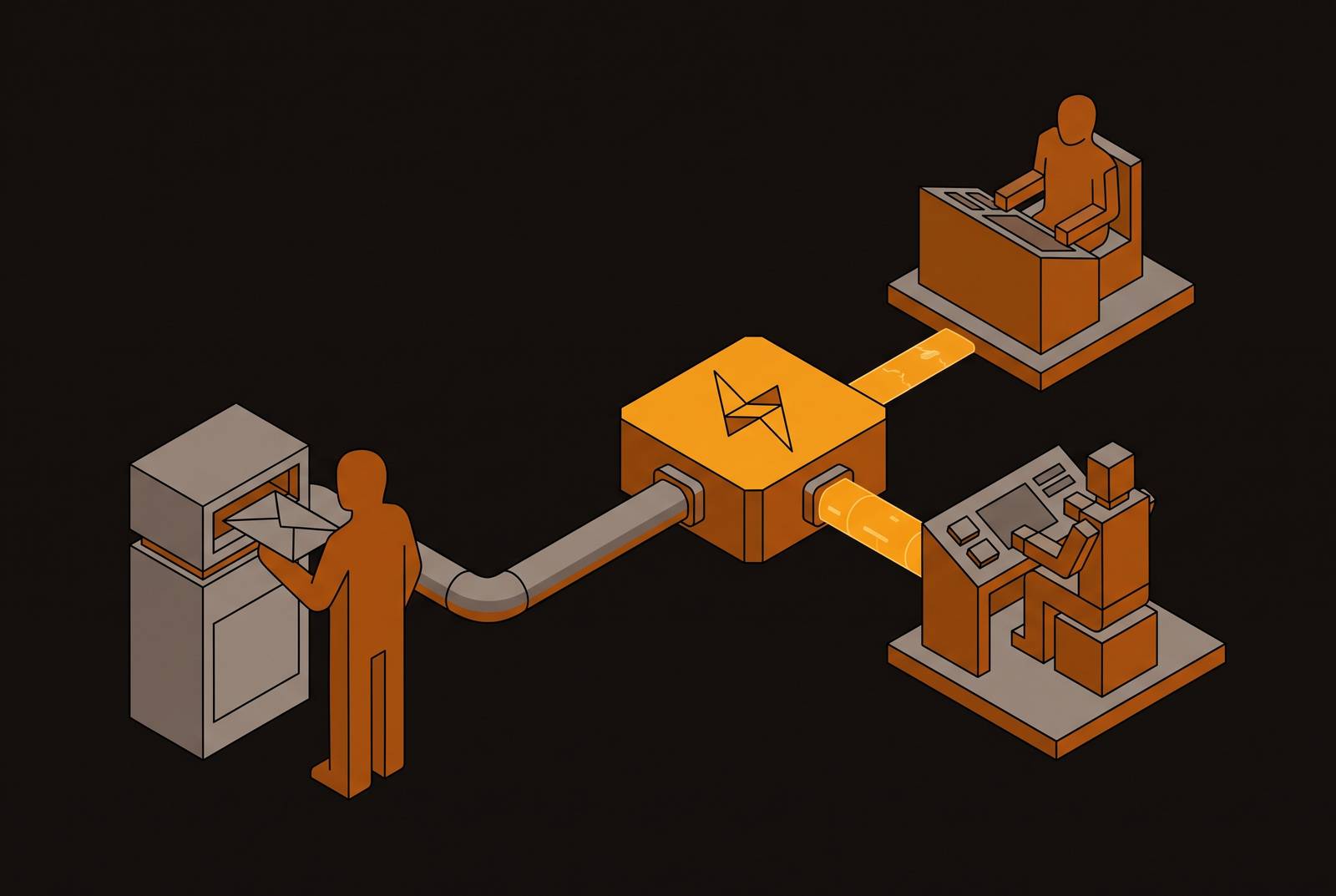
Wiring a reporting channel into agent handoff is not a configuration toggle. It requires three things to be true simultaneously. Every consequential agent action must emit a structured, immutable record. That record must be accessible to the humans positioned to evaluate it. And there must be a named, confidential path for those humans to escalate a concern without it being routed back through the system under review.
The first requirement, the evidence chain, has a defined technical shape. NeoSOFT's controls analysis establishes agent identity records containing agent owner, business purpose, approved environment, permitted systems, permission scope, and expiry date. That identity record is what makes it possible to reconstruct what happened and by whose authority, distinguishing expected autonomous behavior from policy violation or misconfigured permissions. The second requirement depends on the authority model. The Read → Recommend → Execute → Approve sequence provides natural handoff points. Every transition from autonomous execution to human approval is a moment where an employee who sees something wrong has a structurally defined opportunity to escalate. Workflows that emit structured, immutable records at each consequential step are auditable. Workflows that produce after-the-fact text logs are narrated. The difference is the difference between a report that can be investigated and one that can only be described, and it matters most at the moment of examination.
The third requirement is accountability. The State of AI Agent Security Report 2026 found that a substantial share of organizations have no formal accountability structure for AI agent behavior. Without a named owner for each agent, a report about that agent has no clear destination. The channel fails not for lack of use but for lack of routing.
How AI operations audits identify where reporting channels are missing from agent workflows
Most enterprises that fail at AI governance do not fail because their technology was unready. They fail because ownership, handoff accountability, and escalation paths were never mapped. The audit is the instrument that makes those absences visible before a consequential incident makes them undeniable.
An AI readiness assessment that takes agent security seriously is not only a technical audit. It is an organizational one, and the two audits answer different questions. Technical readiness asks what the agents can do. Organizational readiness asks what happens when something goes wrong and who is responsible for finding out. The distinguishing question an examiner applies to agent workflows is not "what did the system do?" but "what can you prove the system did?" The answer to that question determines whether the reporting channel has something to work with or is being asked to investigate a narrated account.
Human handoff points must be explicitly mapped in the audit. That means documenting where AI recommendations require human review, which humans are positioned to observe agent behavior, and whether those humans have a named, confidential path to escalate what they observe. The audit is also where shadow AI enters the picture. Organizations cannot govern what they cannot see, and the first task of an agent security audit is discovery and inventory. That means identifying agents that were deployed without IT approval, are running without monitoring, or are calling tools beyond their intended scope. None of those appear in a reporting channel that was never told they existed.
What the integration looks like across automotive, legal, and healthcare deployments
The reporting-channel integration requirement is shaped by what kind of consequential action the agent takes. The three verticals where agentic deployment is most advanced each present a distinct version of the problem. In healthcare, agents handling revenue cycle, claims, and administrative workflows are operating in production across a substantial share of provider organizations. A 2026 analysis of AI agent security incidents found that 92.7% of healthcare organizations reported a confirmed or suspected AI agent security incident in the last year. So the evidence-chain requirement is both a compliance obligation and a clinical governance concern. The reporting channel must be reachable by the clinical staff who observe agent outputs, not only by IT.
Legal deployments focus on contract review, intake automation, and regulatory tracking, with privilege-touching variants requiring an additional governance control layer. The reporting integration is complicated by the fact that the humans best positioned to observe an agent's legal reasoning error may be the most professionally exposed. Anonymity is not optional in that setting. It is structural to the channel's function. Automotive AI integration is reshaping operational frameworks and compliance standards, and audit efficiency improvements are widely reported. Because agent handoff points in inventory analysis and procurement workflows are high-volume and often fully autonomous, the reporting channel must be calibrated to catch systemic pattern deviations rather than individual transaction anomalies. Across all three verticals, the common requirement is the same. Human-in-the-loop thresholds must be defined before deployment, not discovered after an incident, and the reporting channel must be connected to the agent's own audit record so that a report can be investigated rather than just acknowledged.
Measuring whether the governance integration is working
A reporting channel wired into agent handoff protocols produces measurable governance signals, not just compliance documentation. The absence of those signals is itself a finding, not a clean bill of health. The 2026 State of AI Agents Report found that the majority of organizations deploying agents are already reporting measurable economic returns. The governance argument is not against that value. It is about ensuring the accountability infrastructure scales at the same pace as the fleet, so that the ROI number reflects what agents actually did, not what they appeared to do. The operational signals of a working integration include reports that arrive with a reconstructable agent audit trail attached, escalations that can be routed to a named agent owner, and incident investigations that distinguish expected autonomous behavior from policy violation without relying on after-the-fact text logs.
The ROI measurement problem and the reporting problem are the same problem stated differently. Communicating agent value to boards requires distinguishing autonomous from assistive agent behavior and separating cost avoidance from revenue attribution. That discipline depends on the same structured, immutable evidence chain that makes a report investigable. Organizations with evidence-quality audit trails are measurably ahead on AI maturity metrics. The governance investment is not a cost layered on top of agent deployment. It is the condition under which deployment returns are defensible and scalable. A reporting channel that closes the loop between human judgment and agent behavior is not a safety valve bolted on after deployment. It is part of the accountability architecture that makes production-grade agent deployment possible in the first place.