Structured Complaint Intake Workflows for HR Departments
Structured intake processes turn complaint data into legal defensibility and early warning signals.
- Written by
- Claudine Marchand-Trépanier
- Published
- October 14, 2026
- Reading time
- 8 min read
What this covers
A structured HR complaint intake workflow is not an administrative preference; it is the determining factor in whether a case holds up legally and whether a workplace problem gets resolved before it compounds. The gap between the moment a concern arises and the moment it becomes a documented, actionable case is where risk accumulates fastest, and no investigator has even touched the file yet. Manual, inconsistent intake creates two compounding problems at once: the record becomes unreliable the moment a case escalates to litigation, and the delay built into an informal process lets small issues grow while they sit, untouched, in someone's inbox. Employee grievances work as early warning signals for deeper problems, perceived unfairness, policy gaps, interpersonal conflict among them, and a process that fails at intake silences that signal before anyone in leadership ever hears it. The structural remedy is a defined pipeline, with intake, triage, investigation, resolution, and related stages such as acknowledgment, follow-up, and appeal each mapped out, because the decisions made at each of those stages set both legal defensibility and how quickly a case moves.
Intake capture and standardized submission
Everything downstream depends on what gets collected at first contact. An intake form built with care is the foundation of a legally defensible record, and it's the first filter that makes triage possible in a reliable way. At minimum, an HR intake form needs to capture the identity of the complainant, with a documented process for anonymous submission where that option exists; the nature and date of the alleged incident; the names of all parties involved, including witnesses; whether any informal resolution was attempted before the formal complaint; and the complainant's preferred contact method. Standardization across these fields is the operative goal, because inconsistent data at intake makes pattern analysis across cases impossible later and creates the kind of audit gaps that regulators read as evidence of an inadequate process overall. AI-driven grievance intake systems can apply natural language processing to complaint language at the moment of submission, flagging keywords tied to harassment, discrimination, or retaliation, and cross-referencing those flags against relevant policies or collective bargaining clauses, so the case arrives already structured before a human reviewer opens the file. The intake form itself should trigger an automatic workflow on submission: a log entry is created, a compliance owner is assigned, and the complainant receives confirmation that the submission has been received and is under review.
Triage: separating severity from complexity and assigning ownership
Triage is where a well-built intake pipeline proves its design, or where a poorly built one falls apart. At this stage the workflow has to separate severity from complexity, assign a clear owner, and set an investigation timeline, all without making any judgment about whether the complaint is actually founded. A reliable triage output records the category of the complaint (harassment, discrimination, retaliation, policy violation, interpersonal conflict, safety, or other), a severity rating with a documented one-line rationale behind it, a flag for immediate action if the situation presents safety or legal urgency, and an assigned owner, whether that's an HR generalist, legal, compliance, or an external investigator. AI-assisted triage can produce this output consistently and at a volume no individual reviewer could match working alone; the job at this stage is a clean, consistent record and the right next step, delivered fast. Retaliation detection stands out as one of the higher-value applications of AI at triage: reviewing the timeline of an employee who has filed a complaint and flagging any subsequent action against them, discipline, schedule changes, reassignment, negative performance reviews, while noting the interval between the original complaint and each of those actions. The constraint that governs all of this is precise: AI sorts and structures the report, and it does not decide whether the complaint is true. Human review of the triage output before any case action is taken is not a best practice to be weighed against convenience; it's a structural requirement of a defensible process. Governance, audit trail logging, and human oversight are treated as deployment prerequisites for reliable automated workflows going into 2026.
Documented routing from triage output to investigator handoff
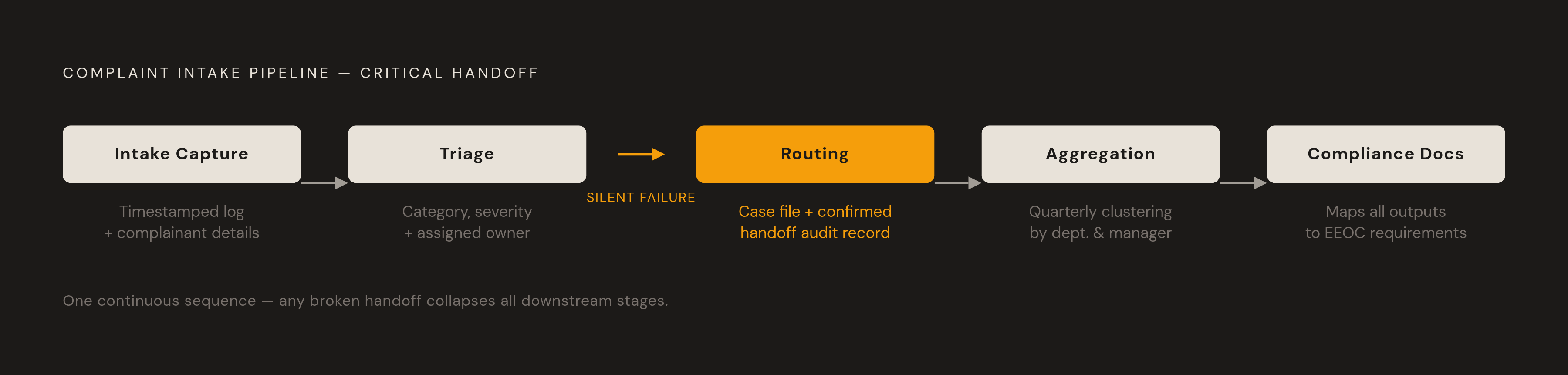
Most informal complaint processes don't fail at intake or even at triage; they fail at the handoff. A triage decision that produces no enforceable routing step accomplishes nothing more than no triage at all, because the case simply drifts from there. A documented routing step has to accomplish three things: it delivers the structured case file, including the triage category, severity rating, and any relevant policy flags, to the assigned owner with confirmation of receipt; it establishes an investigation timeline built around defined milestones rather than a single due date; and it creates an audit record of the handoff itself, one that can be produced in an EEOC review or in litigation if the case gets that far. Cross-system orchestration lets this routing step span HR platforms, legal case management systems, and scheduling tools without manual re-entry at each handoff point, so it closes the gap that otherwise opens between triage and investigator assignment. The handoff should be built so that it cannot be skipped or informally bypassed: agentic workflows can coordinate a complaint intake agent, a case priority agent, and a resolution routing agent operating in sequence on a single complaint, with every step in that sequence logged. Intake, triage, and routing function as one continuous sequence, and the routing step is where that sequence either produces a record that will stand up to scrutiny or quietly fails to.
Aggregating complaint data across cases for pattern analysis
A structured intake pipeline does more than process individual cases correctly; run over time, it generates data that reveals patterns visible only across cases, recurring managers, policy gaps, department-level culture problems that no one complaint would expose on its own. Complaint data should be aggregated on a defined cycle, quarterly being the commonly recommended standard, for pattern analysis alongside adverse impact data, rather than held back until each individual investigation concludes. That analysis should track, at minimum, category distribution over time to catch a complaint type that's growing; clustering by department and by manager; time-to-triage and time-to-routing as indicators of the process's own health; and retaliation flags that trigger after a prior complaint has already been filed. The value compounds the longer the pipeline runs: pattern data informs policy revision, manager training, and resource allocation, turning what started as a reactive case processor into something closer to a proactive operational intelligence system. You can't get any of this without the standardized categories and documented routing described in the preceding sections, and that same data forms the backbone of the compliance record regulators expect to see.
The compliance documentation requirements that a well-built intake pipeline must satisfy by design
A pipeline built the way the preceding sections describe doesn't need a separate compliance layer bolted on afterward; clean documentation is simply what the process produces at every stage, by design. The EEOC's compliance requirements for AI-assisted HR include nine distinct elements, and several bear directly on complaint intake: a log of complaints received with intake timestamps, documentation of the investigation and resolution for each complaint, and recurring analysis of complaint patterns for systemic issues. Each of these maps onto a decision already described: the timestamped log is the output of standardized intake, the investigation and resolution record is the output of documented routing, and the recurring pattern analysis is the output of the aggregation cycle. The enforcement posture behind these requirements is direct: employers remain liable for discriminatory outcomes produced by AI tools they use, regardless of what a vendor claims about bias mitigation, and the complaint process is one of the primary mechanisms through which that liability gets managed. Documentation integrity is, in effect, the compliance payoff of building the pipeline correctly in the first place: AI can substantially speed up the generation of standardized letters, notices, and response templates while maintaining version control, and a properly built workflow enforces the human review step at the points where it matters so that step cannot be quietly skipped.
AI and human judgment in intake and triage
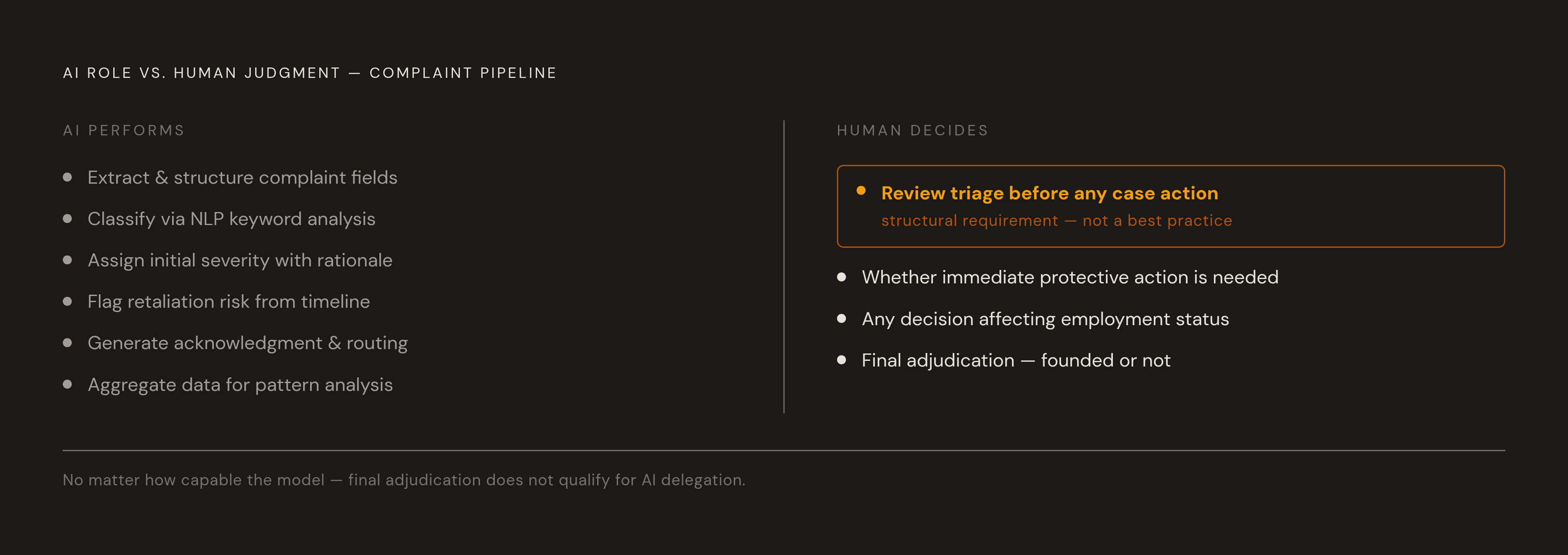
The productivity case for AI in complaint intake is strong wherever the task is bounded, high-volume, and governed by rules that can be demonstrated in advance. The legal case for keeping human oversight in place is equally strong, and it is non-negotiable at the points where a decision carries real consequences for someone's employment. AI performs reliably across several parts of the pipeline: extracting and structuring complaint fields from free-text submissions, classifying complaints into defined categories using NLP keyword analysis, assigning initial severity ratings with a documented rationale attached, flagging retaliation risk based on timeline analysis, generating standardized acknowledgment letters and routing notifications, and aggregating complaint data for pattern analysis across cases. Human judgment remains the required input in a narrower but more consequential set of decisions: reviewing triage output before any case action is taken, where general anti-discrimination obligations under Title VII and established best practice counsel documented evidence of substantive human review rather than a click-through approval, even though no specific EEOC rule mandates this precise step for complaint triage; determining whether a complaint warrants immediate protective action for the complainant; any decision affecting the employment status of the parties involved; and the final adjudication of whether a complaint is founded. The intake-to-triage portion of this workflow fits the criteria for agentic deployment cleanly: it is high-volume, its rules can be demonstrated, and its performance is measurable against clear before-and-after metrics. Final adjudication does not meet those criteria, no matter how capable the underlying model appears to be. Drawing that boundary precisely is what makes the automation defensible.
Assessing readiness for structured workflow automation
Most HR teams already run some version of a complaint process. Far fewer run one that meets the structural criteria for reliable automation or for the kind of legal defensibility current regulatory expectations demand. A given intake process is a candidate for structured workflow automation only if it satisfies three readiness criteria. Volume is the first: the process needs to handle enough complaints that inconsistency becomes a recurring operational problem. Rule-demonstrability is the second: a substantial majority of complaints need to follow a pattern that can be captured in a defined taxonomy and routing logic, and one 2026 analysis found that at least 80% of cases should follow such a pattern before a process is ready for agent deployment. Measurability is the third: there need to be clear before-and-after metrics, time-to-triage, time-to-routing, pattern detection lag, that can establish whether the structured pipeline is actually performing better than what it replaced. An AI readiness assessment evaluates an organization's technical, operational, and cultural capacity before any significant capital gets committed, identifying gaps in data quality, security, and workforce readiness that would otherwise cause a structured intake system to stall once it's deployed. The gaps that most commonly prevent intake workflows from reaching production are rarely technical in nature; governance structure, identity management, audit trail logging, and clearly defined human oversight roles are the typical failure points, and each of them needs to be in place before deployment begins, not addressed as a fix afterward. A structured audit of the existing complaint process, mapping what gets captured at intake, how triage decisions currently get made, and whether routing produces a documented handoff at all, remains the fastest way to identify which stages are already built to hold and which require redesign before automation gets introduced.