AI Agent Intake vs HR Chatbot Intake in Enterprise Settings
The real difference lies in whether the system finishes work or just answers questions.
- Written by
- Renata Osei-Mensah
- Published
- October 13, 2026
- Reading time
- 10 min read
What this covers
Enterprises keep asking the wrong question when they decide between an HR chatbot and an AI agent. The question on the table is usually "which one is smarter, which one sounds more natural in conversation?" That framing puts the meaningful difference in the wrong place. What actually separates these two systems has nothing to do with how fluent the dialogue is and everything to do with what happens the moment that dialogue ends. SHRM's 2026 CHRO Priorities and Perspectives report, based on a survey of 129 CHROs conducted between Oct. 7 and Nov. 5, 2025, found that 92% of CHROs anticipate greater AI integration in workforce operations. That level of intent says nothing about which system belongs on which workflow. A chatbot that can discuss a leave request with real fluency and an agent that can actually process one look identical in a demo, yet they diverge completely the moment an employee needs something done. The question that actually sorts these two tools is simple: does the workflow end when the AI finishes speaking, or does it end when the work itself is finished?
The boundary of an HR chatbot's capability
An HR chatbot's job stops at a well-formed answer. Everything after that answer, whether it's filing a request, updating a record, or routing an approval, gets handed back to the employee or to a human in HR, a handoff that reflects the design the category was built around. Chatbots do a specific kind of work well: resolving FAQs on leave policy, benefits eligibility, and holiday schedules, where the correct answer is identical no matter who's asking; pulling policy information out of a knowledge base without needing to touch any live system; and routing a request to the right queue or the right person. Workativ's 2026 comparison lays out the boundary in table form: a chatbot answers FAQs and retrieves limited employee-specific information, but it takes permitted actions only in limited cases and automates multi-step HR workflows rarely.
This boundary is visible clearly around leave requests. A chatbot can explain the leave policy in detail. It cannot check this particular employee's balance, apply the policy to this particular request, submit it, route it to the right approver, and confirm the outcome. Read-only access to the HRIS is the condition that defines what a chatbot is, not a gap someone forgot to close. The moment a system gains write access and the workflow logic to act on it, it has left the chatbot category entirely and become something else. None of this makes the chatbot the weaker tool. It means the chatbot is built for a specific job, and the trouble starts when enterprises ask it to do a different one.
The four operational prerequisites that make action possible
An AI agent is a system that satisfies four operational conditions a chatbot doesn't need, and those four conditions are what let it move from understanding a request to finishing it. The 2026 HR agent roundup lays these out.
The first is write access to integrated systems. Read-only access leaves any system recommending instead of doing; the HRIS connection has to let the agent submit, update, or trigger something, or none of the rest matters. The second is a defined process. An agent can't invent the leave policy on the fly. It can only execute a workflow that's already documented and owned by someone in the organization. The third is permissions tied to real user identity, so the agent never surfaces one employee's records to another and every action it takes can be traced back to a specific, authorized request. The fourth is a clean escalation path: for anything that falls outside the defined script, the agent has to know the point at which it stops acting and hands the matter to a person.
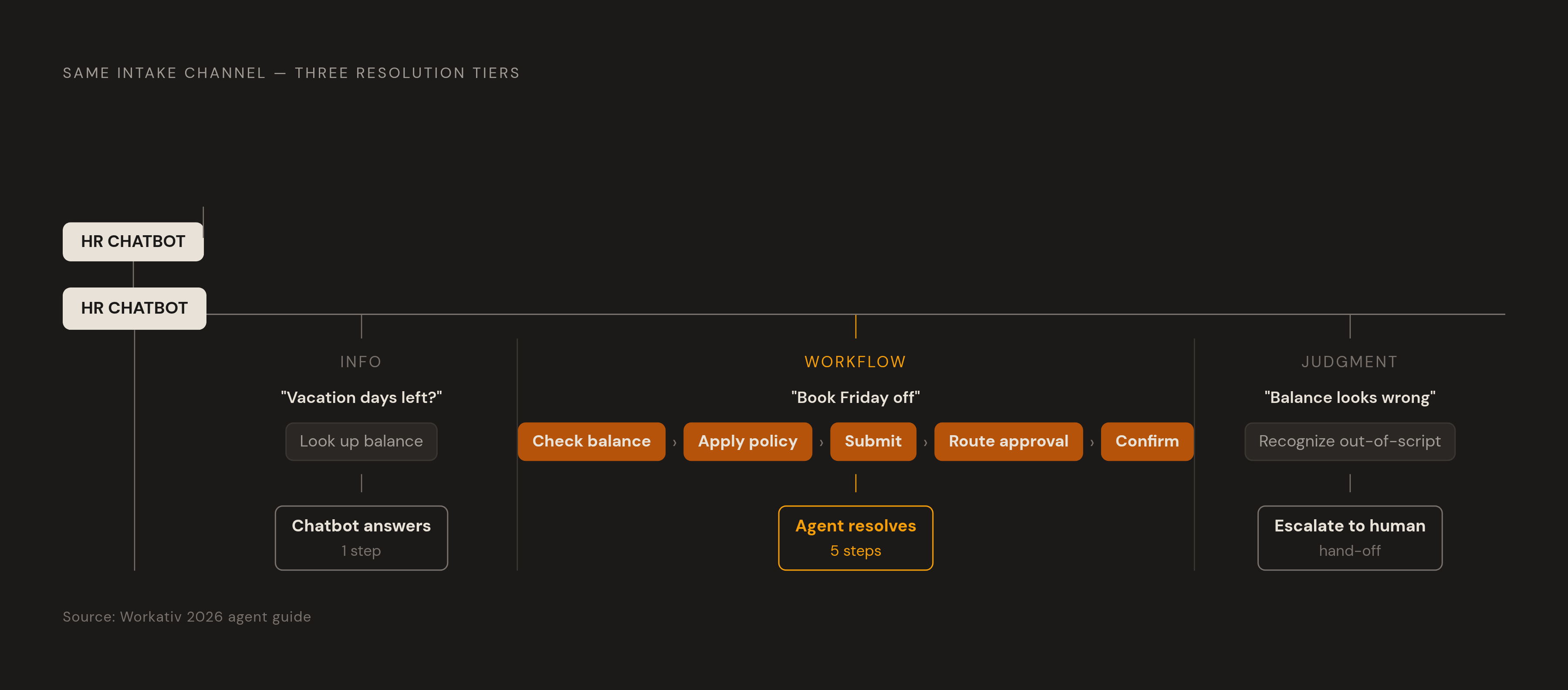
When those four conditions are in place, the difference becomes concrete. A chatbot answers a question about proof of employment. An AI agent generates the letter, pulls the correct dates from the HRIS, and emails it to the employee. The leave request shows the same gap at greater scale: per Workativ's enterprise chatbot guide, an agent checks the employee's leave balance, applies the relevant policy, submits the request, routes it for approval, and confirms the outcome, while a chatbot only completes the first of those five steps.
None of this means an agent should run without limits. Approvals with legal weight, employee relations matters, contested decisions, and anything that calls for human judgment and empathy stay with a person regardless of what the agent is technically capable of doing. The workable pattern is human-in-the-loop: the agent prepares and executes the action, and a person reviews and signs off where the stakes call for it. This distinction, write access, a defined process, tied permissions, and an escalation path, is what separates a conversational tool from a system built to finish work, and it's the basis enterprise AI agent deployments use to evaluate whether a given use case will actually produce measurable return.
Two workflows for the same HR intake request
An HR intake request, followed from the moment an employee submits it to the moment it's resolved, makes the right tool for the job obvious. Workativ's 2026 agent guide offers three requests that sort cleanly along this line.
"How many vacation days do I have left?" needs information and nothing more. A chatbot resolves it completely, start to finish, in a single answer. "I want to take Friday off" needs a workflow, not an answer. A chatbot can confirm what the policy says, but the request goes nowhere from there: nothing gets submitted, nothing gets routed, nothing gets confirmed, unless an agent is the one handling it. "My leave balance looks wrong" needs a human to look at it. The right move for an agent here is to recognize that the request sits outside its defined script and escalate it, not to attempt a fix on its own.
What separates these three isn't how complicated the question sounds. It's whether resolving the request requires a system action once the conversation is over. A request that ends with information belongs to the chatbot, no matter how nuanced the phrasing. A request that ends with a record update, a generated document, a routed approval, or a system trigger belongs to the agent, no matter how simple the instruction sounds on its face.
Scheduling makes the same point from a different angle. The AttendanceBot 2026 agentic AI review notes that a system which sends an alert when a shift goes uncovered hasn't actually solved anything. It simply shifts the problem back to a human, now in digital form. An agent, by contrast, identifies which team members are available, checks their hours and preferences, proposes a resolution, and confirms it, all before a manager ever has to step in.
Why most enterprises run chatbots where they need agents
Pilots get built around how well the AI converses, not around whether it finishes the work, and that's precisely why so many enterprises don't discover the mismatch until the system is handling real volume. A pilot with a handful of test users rarely surfaces the gap between answering and acting, because small-scale testing doesn't put enough pressure on the system to expose where it stops short. The mismatch only becomes visible once real employees are submitting real requests at real volume, by which point the chatbot has already been scaled into a role it was never built to fill.
A survey of 650 enterprise technology leaders found that AI agent pilots are now nearly universal, with 78% of respondents, all VP of Technology or above, reporting at least one pilot running. Successful production deployment, by contrast, remains rare. That gap isn't a technology problem. The models involved are capable enough; what's missing is the evaluation infrastructure, the monitoring tooling, and the ownership structure needed to carry a pilot into dependable production use.
Mid-market organizations run into this gap in a handful of recurring ways: data that exists somewhere in the organization but isn't accessible to an AI system in any usable form; a use case defined so broadly that no single workflow inside it is ever fully documented; nobody assigned to own the AI's output once it's produced; on-premises infrastructure with no realistic upgrade path; and, most often, pilot success getting mistaken for production readiness when the two are different things.
Governance risk compounds all of this. A chatbot's worst-case failure is a wrong answer. An agent's worst-case failure is a wrong action, and plenty of organizations deploying agents haven't yet built the audit trails or the guardrails that wrong actions demand. The fundamental misalignment here, between what enterprises think they're choosing and what they actually need, mirrors a pattern across the industry: deployment approaches that reward conversational polish over whether the workflow actually gets completed. Eigenomic, which focuses on deploying enterprise AI agents across operational domains, measures success by whether the system owns and finishes the complete workflow rather than by how well it holds a conversation, a standard that reframes the entire chatbot-versus-agent question from the start.
What a readiness audit examines before an enterprise chooses between the two systems
Choosing between a chatbot and an agent before auditing workflow documentation, system integrations, data readiness, and permissions architecture is how an enterprise ends up deploying the wrong tool at scale. A serious readiness assessment covers seven dimensions. Strategy and business case ties each initiative to a named metric and a real P&L outcome. Leadership and operating model puts a named executive sponsor in charge with explicit decision rights. Data readiness means clean, governed data with traceable lineage, not just data that happens to exist somewhere. Talent and AI literacy requires defined roles and a baseline of AI literacy across the organization, not just inside one team. Governance, risk, and ethics calls for a usage policy with active controls against shadow AI use. Process maturity asks whether workflows are documented and instrumented, not just understood informally by the people who run them. Culture and change readiness measures whether teams will actually adopt new workflows and whether failure, when it happens, is survivable.
Process maturity carries the most weight of the seven when it comes to the chatbot-versus-agent decision specifically. An agent cannot execute a workflow that has never been written down and assigned an owner. If the leave-request process, for instance, lives only in the institutional memory of a few people in HR, the organization isn't ready to put an agent on that workflow, no matter how capable the underlying model is. The audit's job is to identify which workflows are mature enough to support an agent right now and which ones still belong with a chatbot until the underlying conditions, documentation, ownership, integration, are in place. Eigenomic's own approach to this runs through what it calls an AI Operations Audit: talking to the team, watching how the work actually gets done, and returning with a ranked list of what to automate first, along with the ROI math and a 90-day plan. That readiness-first sequence is what lets an organization get a production-ready agent live within weeks instead of discovering mid-deployment that the workflow was never documented.
Measuring whether the deployed system is finishing the work
It is visible instead in whether the workflow actually gets completed, and the metrics for measuring the two are not interchangeable. Session count, message volume, and deflection rate as a raw number tell you the system got used. None of them tell you whether the work got done.
The metrics that actually answer the question, for HR intake specifically, run at the level of the workflow rather than the conversation: automatic resolution rate, the share of requests completed without any human stepping in; workflow completion rate, whether the process reached its actual end state and not just a satisfying reply; escalation rate, how often the system correctly recognized it needed a human's judgment; human touches per request, where a declining count over time means the agent is absorbing more of the work; failed actions, which flag agent errors that needed manual correction and signal where wrong-action risk is showing up; time to resolution measured end to end rather than just response latency; and employee satisfaction, the downstream signal that the resolution actually landed with the person who needed it.
The measurement standard itself has moved. Futurum Group's survey of 830 IT decision-makers in the first half of 2026 found that direct financial impact, combining revenue growth and profitability, nearly doubled to 21.7% of primary success metrics cited, while productivity gains as the leading success metric fell by 5.8 percentage points. Boards increasingly want to see the line connecting an AI deployment to the P&L, not another activity dashboard. Eigenomic anchors every engagement to ROI from day one on this same basis: the distinction between acting and answering matters in practice when an organization is tracking whether the work got finished. An enterprise that applies these metrics consistently will know within a single quarter whether the system it deployed was the one the workflow actually required.