Multilingual Complaint Intake for Multinational Workforces
AI agents must route complaints to the right policy and escalation path, not just translate words.

Multilingual complaint intake for multinational workforces is an operational problem. For intake to work, AI agents must own the full workflow and link each complaint to the right locale-specific policy, compliance rule, and escalation path. The standard is not whether the system understands the employee’s words, but whether it executes the process those words set in motion.
Why translation is the wrong frame for multilingual complaint intake
Consider a foreign-language harassment complaint that is fluently translated but routed against US policy because the system does not know the incident occurred in another country. Nothing in the translation needs to be wrong for the intake to fail. The error lies in the jurisdiction the system applies and the escalation path it selects. A fluent response cannot repair that mismatch, and may conceal it from anyone assessing only the quality of the language.
The word multilingual covers three different things: UI language, answer language, and source-document language. An assistant can present a Japanese interface and reply in Japanese while drawing from a single English policy document that does not reflect Japanese labor law. For complaint intake, the distinction is consequential because overtime, discrimination, and safety complaints must be assessed against the law of the country where they occurred. Translation fluency and operational accuracy are independent, so success at the language layer says little about whether a complaint has entered the right process.
How a complaint travels — and where the workflow breaks without locale-aware routing
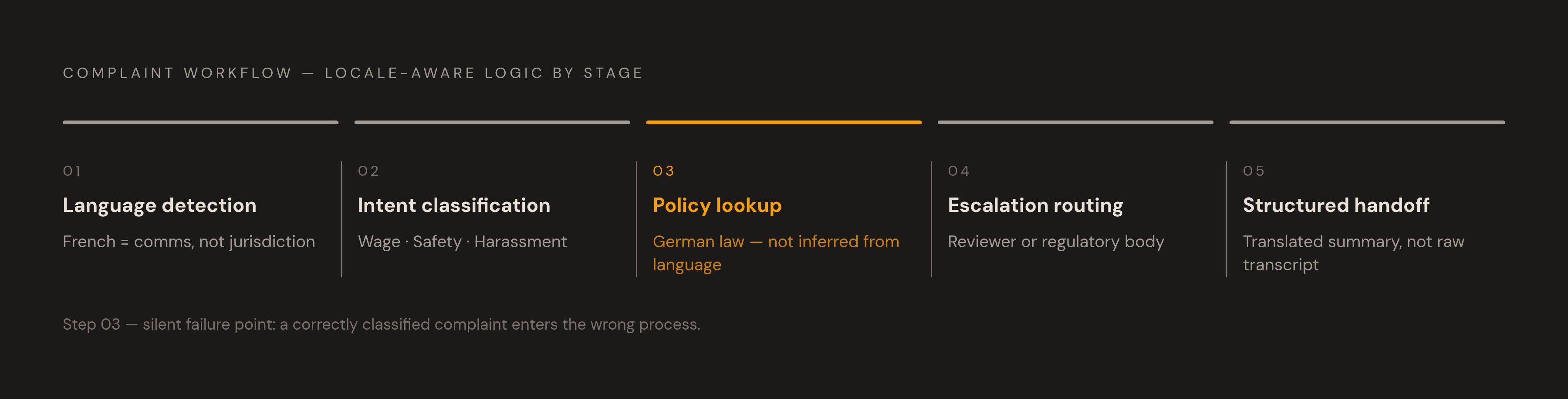
A hypothetical wage complaint from a worker speaking a nonlocal language in a German subsidiary shows where those processes diverge. In the first step, the system detects language and locale at submission. French determines how the complaint is understood and communicated, but it does not establish the governing jurisdiction. In the second step, intent classification identifies the submission as a wage dispute rather than a safety complaint, discrimination allegation, or harassment report. The system now has distinct inputs for communication and for routing.
In the third step, policy lookup links the complaint to the labor law, data-handling rule, and HR policy that apply to it. For this hypothetical complaint, that means retrieving the German sources rather than inferring jurisdiction from the language of the complaint. In the fourth step, escalation logic decides which human reviewer, legal team, or regulatory body gets the case under local law. Without locale-aware logic, a complaint can end up on the wrong escalation path even if its classification is right.
In the fifth step, the reviewer receives a structured summary in the working language, with the translated context intact. A raw multilingual transcript is not an equivalent handoff because it requires someone who may not speak its languages to interpret it. That reviewer must then reconstruct the context before addressing the complaint. A system that translates the submission but leaves policy lookup, escalation, and handoff to manual work has automated only one part of intake.
Why locale-accurate policy content is harder to maintain than the AI itself
Even an advanced routing engine gives wrong answers when it draws on machine translations of a single English document in place of jurisdiction-specific, human-reviewed sources. The distinction is between translating an existing rule and establishing which rule applies. Engineering can connect a complaint to a document, but that connection does not establish the document’s legal fitness for the jurisdiction. Policy content is therefore often the binding constraint.
Policy content has distinct levels of quality and risk. Raw machine translation of headquarters policy can read well and still be legally wrong, so it carries the greatest risk of liability. AI-translated content with human review can be acceptable for low-stakes material, but it is insufficient for statutory entitlements. High-stakes content needs a human-reviewed, jurisdiction-specific fork, which is a separate version of the policy for that country. That distinction matters for leave entitlements, benefits eligibility, data-handling rules, and statutory notice periods because the right answer can change from one jurisdiction to another.
The argument for maintaining everything through AI translation at scale misses where errors matter most. Routine language conversion is not the same task as maintaining accurate overtime calculations, protected-class definitions, or mandatory reporting timelines. Those edge cases can create direct regulatory exposure even when ordinary queries receive adequate answers. Locale-accurate content is therefore a governance and legal function because its correctness depends on the underlying rule.
The governance gap that makes multilingual intake a compliance liability when it goes live without it
Inaccurate policy content creates wider compliance risks when an agent goes live before its governance rules are set. At that point, the system handles sensitive personal data across jurisdictions before there are clear rules for how to handle it. The organization must define the conditions under which the agent may receive, retain, disclose, and act on a complaint. Governance is a precondition for those operations.
Before go-live, the framework must establish the lawful basis for processing complaint data in each jurisdiction and the retention rules that apply by locale. A complaint from a German employee may have a different mandatory retention period from one submitted by a Brazilian employee. Regional hosting requirements set where complaint data may be stored, while role-based access controls set who may see it and in which country. These rules govern the same case even when its translated summary is intended for a reviewer elsewhere.
Human oversight checkpoints must also specify which complaint categories require review before any action is taken. Audit logging must provide a verifiable record of what the agent did, in which language, and against which policy version. Building governance in parallel with deployment leaves an exposed interval because a complaint mishandled before those controls exist cannot be retroactively governed.
What production-ready multilingual intake actually looks like in operation
N26 moved from a manual, document-heavy payment-dispute process to an AI system that evaluates evidence and returns structured decisions. The AWS Summit Hamburg 2026 session on N26’s deployment describes analysts previously translating non-English documents and cross-referencing Mastercard criteria. The relevant change was not translation alone, but the movement from manual document handling to structured evaluation. Payment disputes are not workforce complaints, but the example illustrates the architectural shift from language assistance to process execution.
Healthcare intake follows a similar pattern, using classification to find the chief concern and route the case to the right care level. For workforce complaints, the same pattern links what the employee says to a complaint category and the right escalation path. Healthcare workflow deployments also illustrate that the operational gain comes from coordinating existing systems. For workforce intake, those systems include HR platforms, ticketing systems, and case management tools that work together through an AI coordination layer.
Legal intake adds the intake-to-engagement sequence, where automation compresses work that previously required days of manual handling. The multilingual version takes submissions through conflict-check and case-creation logic before a human reviewer touches the file. These examples establish a workflow model. Complaint intake that is ready for use draws on that model for language detection, intent and jurisdiction classification, locale-specific policy retrieval, and translated handoff. Complex or high-affect cases then move to human review as part of the process.
Where AI handles intake alone and where human judgment is required
Workflow ownership does not mean unrestricted autonomy. In a human-AI hybrid, the agent executes every step it is authorized to execute and routes the case to a person wherever human judgment is required. That boundary is an explicit design decision, documented and built into the routing logic.
Harassment allegations, safety reports, and discrimination claims need people to own their resolution even when intake is automated. Alyahya et al. (2026) recommended that emotionally intense complaints be escalated to human agents in good time. That finding supports a clear point for moving from automated triage to human handling based on the complaint category. For high-affect cases, the human review checkpoint includes delivering a tailored explanation and communicating ownership of the resolution.
The agent’s responsibilities remain substantial before that checkpoint. It classifies severity and affect level, selects the handoff path, and produces a structured, translated case summary that preserves the context for the reviewer. It also maintains an audit trail of its decisions and their basis. The human reviewer then handles adjudication, ownership communication, and regulatory notification where required. A sound handoff gives that reviewer the material needed for judgment without requiring the intake work to be done again.
How to assess whether an existing intake system is built for this or built around it
A readiness assessment begins with data rather than the number of languages a platform advertises. Are complaint records set up the same way across country instances, or kept in separate language-specific CRMs that cannot share context? A system built for multilingual execution removes those barriers so a reviewer is spared the work of bridging them. Data readiness is therefore the first diagnostic layer.
Locale accuracy is the second layer, and it requires inspecting the policy source. A useful test is to file a complaint involving a statutory entitlement that differs by country and check which policy version the system retrieves. Routing logic is the third layer. The relevant test is whether the system determines jurisdiction and escalation from the complaint content and employee’s location, or waits for a person to make that determination afterward.
Governance infrastructure is the fourth layer. A documented agent registry records what each agent does, in which language, against which policy version, and with what access controls. Without that record, the system cannot be audited, and in regulated industries that is itself a finding. An AI Operations Audit across these layers exposes where production behavior falls short of claimed capability. The number of languages covered tells less than that evidence because correct answers across fewer locales serve employees better than a generic policy translated into many languages. The diagnostic establishes where the gap lies, but closing it requires changes to the operating process.
What it takes to move from translation-layer intake to end-to-end workflow ownership
Closing that gap requires connected work on data readiness, locale-accurate content, routing logic, governance infrastructure, and human-AI handoff design. These parts depend on one another because a correct source is useful only if the right complaint reaches it, and a correct routing decision is useful only if the case can be handed off lawfully. The transition begins with an audit of the four diagnostic layers before any agent is deployed or modified.
The next work is to build locale-accurate policy content for jurisdictions with the highest complaint volume, with attention to the highest stakes. Routing and escalation logic must then follow the rules that apply in each jurisdiction in place of what headquarters assumes. Human oversight checkpoints must be defined before go-live. Deployment begins in a single high-volume, high-stakes market, with performance measured through complaint resolution time, escalation accuracy, and policy citation accuracy before expansion.
Success means that a complaint filed in any language, in any jurisdiction where the organization operates, reaches the right reviewer under the right policy with its context intact. Language becomes one handled input within an operational process subject to the same rigor as the rest of intake. The organization must assess whether the AI owns the intake process beyond translating complaints.